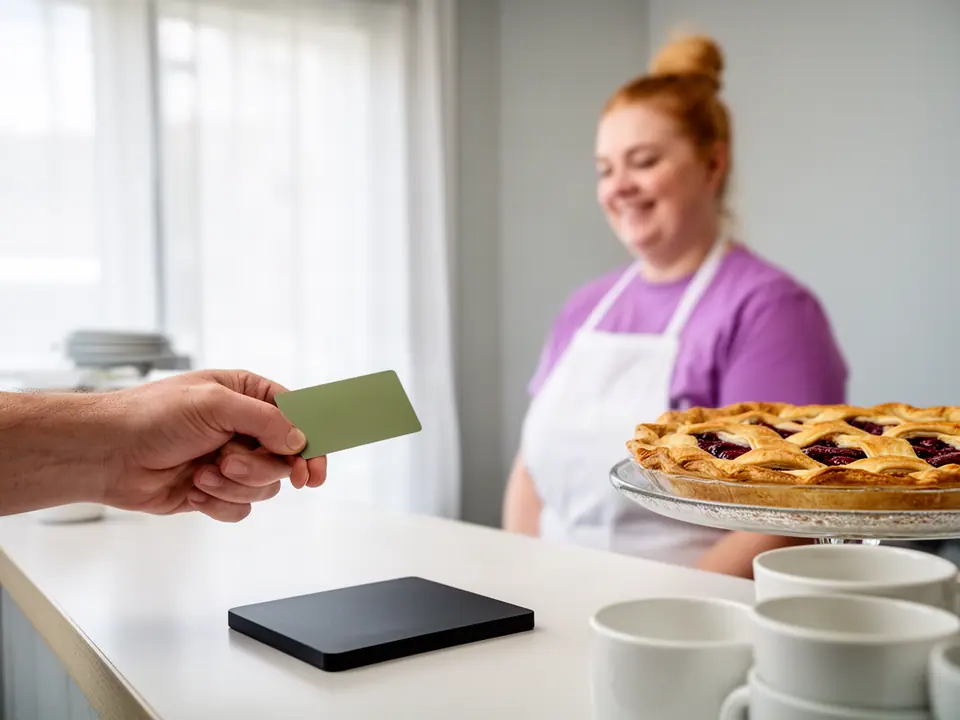
Card-heavy businesses such as an auto repair shop at the counter are the fit, and two numbers decide the cost: the factor rate and the holdback.
This is not a loan; the provider is buying card sales the business has yet to make. The factor rate sets the total collected; the holdback sets the share of each day's card sales taken until that total is reached. It fits businesses with steady card volume.
At a glance
- Limited-service restaurants, Union County, OH
36 employer establishments (CBP 2023, NAICS 722513)
- Beauty salons, Union County, OH
11 employer establishments (CBP 2023, NAICS 812112)
- Auto repair and maintenance, ZIP 43040
17 employer establishments with a ZIP 43040 address (ZBP 2023, NAICS 8111)
Revenue-based financing or a merchant cash advance: notes for Marysville, OH quick-service restaurants
Revenue-based financing is a broad label for money that is collected as a share of a business's revenue instead of on a fixed schedule. Some products in that family take a percentage of all deposits each month. A merchant cash advance is the card-sales version: the provider collects from card transactions, daily, until the agreed total is in.
The revenue-based option this site arranges is the merchant cash advance, and only for a business that takes card payments. A quick-service restaurant ringing orders through a card terminal at the counter has that volume. A landscaping company fits only if its customers pay by card; a crew paid by check or invoice has little for a provider to collect from, and a line of credit is the better place to look.
In Union County, OH, the 2023 County Business Patterns list 36 limited-service restaurants, the NAICS code (722513) that takes in counter-service and quick-service restaurants.
What a holdback rate means for a Union County, OH auto repair shop's card sales
Think of the holdback as the provider's cut of each card batch: a fixed percentage, taken every business day, that stops only once the agreed total has been collected. That cut can run through the card processor, which splits each batch before the rest reaches the shop's account, or through a fixed daily or weekly debit that is meant to approximate that percentage.
Illustration only, invented figures: a repair shop averages $2,350 a day in card sales and agrees to a 9% holdback. On an average day $211.50 goes to the provider; on a $1,800 day it is $162.00. With a true percentage split the amount follows the sales. With a fixed debit, ask whether the agreement lets the amount be adjusted when card sales fall.
Inside ZIP 43040 alone, which reaches past the Marysville city limits, the 2023 ZIP Code Business Patterns located 17 auto repair and maintenance establishments (NAICS 8111).
How to calculate a factor rate before a Marysville, OH restaurant owner signs
Divide what the provider will collect by what it advances, and the answer is the factor rate. It is a multiplier, not an annual rate, and it is fixed when the agreement is signed. To work it out from an offer:
- Take the advance amount the offer names, and note any fee taken out before the money lands.
- Find the total the provider will collect; some offers state it, others state only the factor.
- Divide the total by the advance: that quotient is the factor rate.
- Subtract the advance from the total to get the cost in dollars, then set that cost beside how long collection may take.
Illustration only, invented figures: a restaurant owner is offered $24,000, with $30,720 to be collected. Dividing $30,720 by $24,000 gives 1.28, and the cost is $6,720. At the 9% holdback and $2,350 a day from the example above, collection would run about 146 business days; at $1,800 a day, about 190. The dollar cost is the same either way unless the agreement offers an early-payoff discount, which is worth asking about.
Merchant cash advance or line of credit: which fits a Union County, OH auto shop's card sales?
| Point | Merchant cash advance | Line of credit |
|---|---|---|
| What it is | A purchase of future card sales | A credit limit to draw from |
| How the money goes back | Collected as a slice of each day's card batch | Payments on the balance drawn |
| Cost | Fixed by the factor rate at signing | Interest that runs only on the drawn balance, while it stays drawn |
| Using it again | A new agreement | Draw again up to the limit |
| Fits | Steady card volume and a short-term need | Costs that come and go |
An auto shop with a parts bill to cover and steady card volume at the counter could look at either. The line charges only for what is used, and it can be drawn again; the advance costs a fixed amount however soon it is collected. A shop with the bank history a line partner can ask for may price the line first and keep the advance as the other option.
How does a merchant cash advance work for a card-taking Union County, OH retail store?
- Card processing statements and bank statements from recent months go to the provider, who reads daily card volume from them.
- Four numbers belong on any offer: the amount advanced, the factor rate, the holdback and the total the provider will collect.
- After signing, the advance lands in the business account, minus any stated fee.
- Each business day the holdback is collected from card sales, or a set debit is taken.
- Collection stops once the agreed total is in; a renewal is a new agreement with new numbers.
A retail store with a card terminal at the register fits this pattern. For a sense of the local retail base, the office ZIP, 43040, held 82 retail trade establishments in the 2023 ZIP Code Business Patterns (NAICS 44-45). A store that sells mostly through invoices to other businesses has less card volume, and an advance sized to it would be small.
What is a factor rate in an MCA, explained for a Union County, OH salon
Two offers on the same advance can differ by the factor alone. Illustration only, invented figures: a salon with $940 a day in card sales and an 11% holdback sees $103.40 go to the provider on an average day. It compares two offers on $9,500:
| Point | Factor 1.24 | Factor 1.36 |
|---|---|---|
| Advance | $9,500 | $9,500 |
| Total collected | $11,780 | $12,920 |
| Cost of the advance | $2,280 | $3,420 |
| Business days to collect, about | 114 | 125 |
The higher factor costs $1,140 more and runs about 11 more business days at the same card volume.
For the real local count, County Business Patterns put 11 beauty salons with paid employees in Union County, OH in 2023 (NAICS 812112).
To rerun the comparison with real offers, type the advance, the factor rate from the offer, the holdback percentage and the average daily card sales into the calculator on this page; its estimates cover what will be collected, what the advance costs and roughly how many business days collection takes. The Marysville, OH page carries the 2023 Union County, OH count of limited-service restaurants, one kind of business that takes card sales.
By Reedshore Credit · Updated